
Understand Ethernet Cable Categories: Complete Guide for Home Renovation Wiring
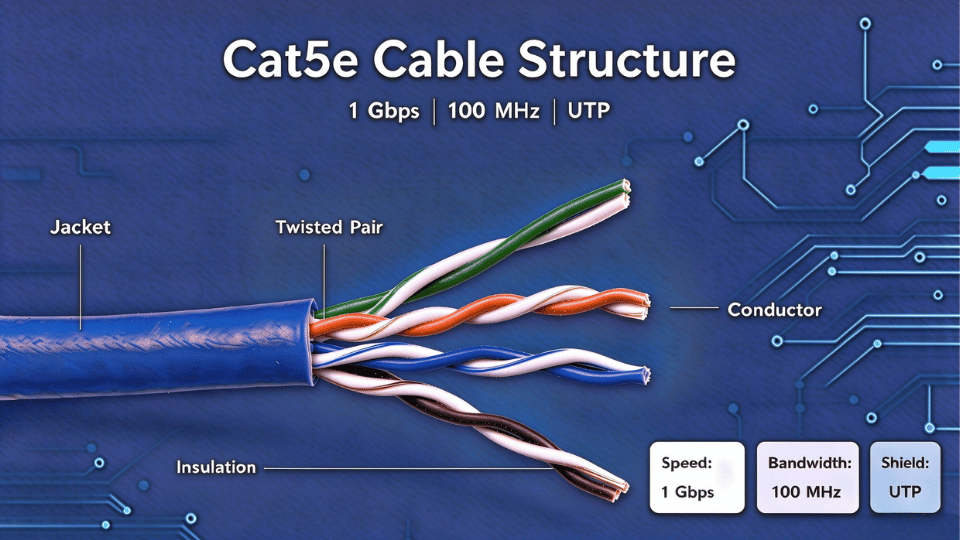
Cat 5e — Sufficient for Gigabit Networks
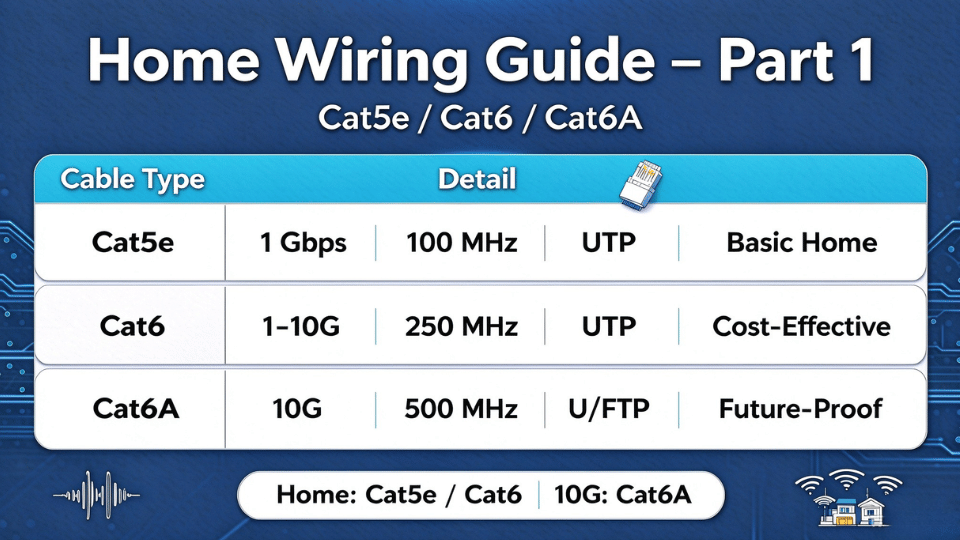
- Speed: 1 Gbps | Bandwidth: 100 MHz
- Key takeaway: If you only need standard gigabit networking and prioritize budget, Cat 5e works well and saves costs.
Cat 6 — The Sweet Spot for Home Use
- Speed: 1 Gbps (10 Gbps supported within 55 meters) | Bandwidth: 250 MHz
- Key takeaway: Built‑in cross‑separator improves anti‑interference performance. Cat 6 delivers excellent value‑for‑money for home deployment and supports 10‑Gigabit speeds over short distances.
Cat 6A — Future‑proof Your Network ⭐
- Speed: Stable 10 Gbps across full 100‑meter distance | Bandwidth: 500 MHz
- Key takeaway: For new‑build home wiring with high‑performance network requirements, Cat 6A is the ideal one‑and‑done choice. It supports 10G‑NAS, 8K video streaming, and Wi‑Fi 6 / Wi‑Fi 7 access‑point backhaul. Spend a little extra and stay future‑ready for years to come.
Cat 7 — Think Twice Before Buying
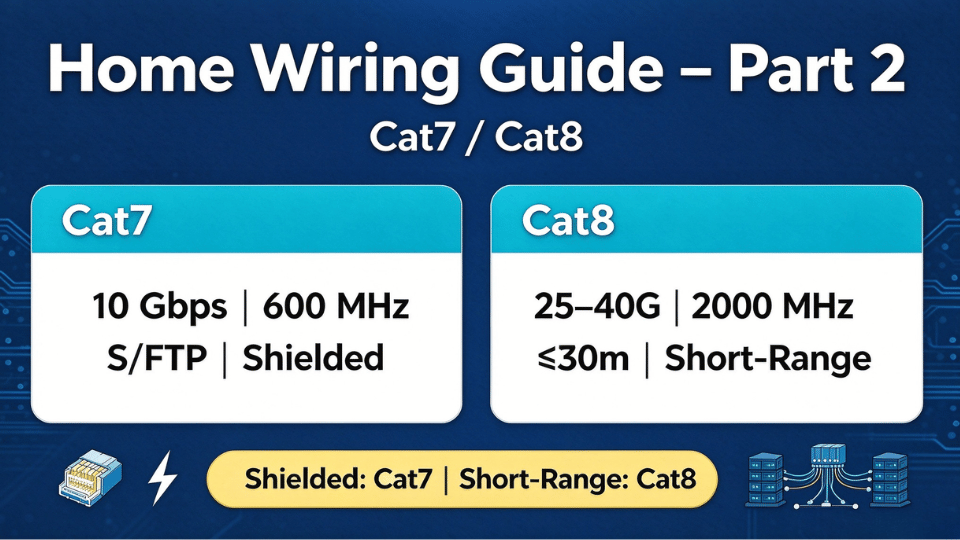
- Speed: 10 Gbps | Bandwidth: 600 MHz | Double‑shielded construction
- Key takeaway: Important caveat: Cat 7 follows the ISO/IEC standard but is not defined under TIA cabling specifications. Most retail‑sold Cat 7 cables use standard RJ45 connectors instead of native GG45 connectors, so they cannot deliver full Cat 7 performance. Real‑world performance is roughly equivalent to Cat 6A, yet sold at a higher price. Cat 7 is generally not recommended for residential deployments.
Cat 8 — Designed Exclusively for Data Centers
- Two variants exist: Cat 8.1 and Cat 8.2. Maximum reach is limited to 30 meters for short‑range data‑center interconnections.
- Speed: 25‑40 Gbps, but only valid up to 30 meters. Built for server‑room environments and completely unnecessary for home use.
✅ Three Critical Pitfalls to Avoid
-
Higher price does not equal better performance: Cat 6A represents the performance ceiling for most home networks. Higher‑grade cables are wasteful for residential scenarios.
-
Shielding does NOT increase speed: Shielded twisted‑pair (STP) cables only improve resistance to electromagnetic interference, they do not boost throughput. Proper, reliable grounding is mandatory for shielded cables to function correctly. For most household installations, unshielded twisted‑pair (UTP) cables are sufficient. Poor grounding on shielded wiring may even introduce extra interference. Most home‑renovation cabling projects should stick with UTP.
-
Always choose pure‑copper conductors: Avoid CCA (copper‑clad‑aluminum) cables. This is especially important for PoE power delivery and 10‑Gigabit applications. Look for genuine oxygen‑free copper cabling.
💡 Final Buying Recommendations
- Ordinary home gigabit networks → Cat 5e or Cat 6: capable and cost‑effective
- New‑home wiring, plan for future upgrades → Cat 6A for future‑proof deployment (strongly recommended)
- Enterprise data‑center or heavy electromagnetic‑interference environments → Only then consider shielded cabling or Cat 8
Closing note: For 90% of households, solid‑copper Cat 6 or Cat 6A will satisfy all requirements. Do not fall for marketing hype around Cat 7 and Cat 8 consumer‑grade cables.